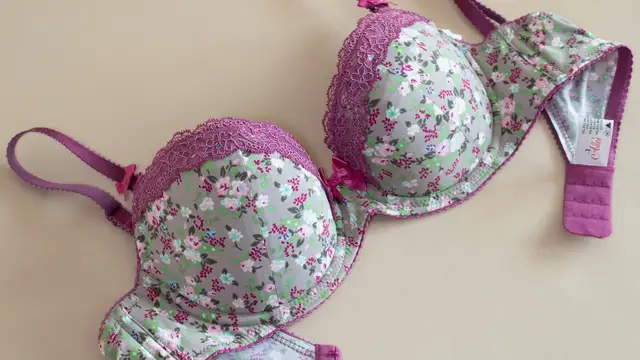
A plunge bra has a low, narrow center between the cups, with cups that angle inward. That low center lets it stay hidden under deep V necklines and wrap tops, where a standard bra would peek out.
What does a plunge bra look like?
The defining feature is the center gore, the small panel between the cups. On a plunge bra it sits much lower than usual, often just a short V. The cups are cut on an angle, with less coverage toward the middle. Marks & Spencer calls it “your go-to for low-cut moments”, and Bravissimo notes plunge bras give “less coverage than other types of bras” while still offering “great lift and support”.
Common features:
- Low, narrow center gore, often an inch or two tall.
- Angled cups with less coverage toward the center.
- Straps set closer to the center than a balconette.
- Wired or wireless, molded or seamed, padded or unpadded.
Plunge bra vs push-up bra
These get mixed up because many bras are both. The difference:
- Plunge describes the shape: a low center.
- Push-up describes padding that pushes the breasts up and in.
A plunge bra can be completely unlined. A push-up bra can have a fairly tall center. When a bra is both, you’ll see it called a “plunge push-up”. Our guide to the push-up bra explains how the padding works.
Plunge vs balconette
| Plunge | Balconette | |
|---|---|---|
| Center | Low and narrow | Moderate |
| Top edge | Angled toward the center | Straighter, horizontal |
| Straps | Closer together | Often wider-set |
| Best under | V-necks, wrap tops | Square and wide necklines |
If your breasts are wide-set, a balconette bra often follows your shape better. If they’re close-set, a plunge usually sits more comfortably.
Who does a plunge bra suit?
Plunge bras often suit:
- Close-set breasts, where a tall center gore would sit on breast tissue.
- Smaller frames with narrow ribcages, because the cups are angled rather than wide.
- Fuller upper breasts, since the angled cups leave room at the top.
They can be trickier if your breasts are far apart or if the low center lets tissue spill toward the middle. The style comes in a wide range of sizes, so cup size alone isn’t the deciding factor.
How should a plunge bra fit?
- Center gore: rests against your breastbone, even though it’s low.
- Inner edge: no tissue pushed over the inner edge of the cups.
- Wires: sit behind your tissue at the sides without digging into your underarm.
- Band: firm and level. A loose band makes a plunge gape at the center.
- Straps: stay put without pulling.
If the gore floats away from your chest, the cups may be too small or too shallow. The bra fit checker can help you work out which.
What to wear with a plunge bra
- V-neck and wrap tops and dresses.
- Low-cut blouses where a regular center would show.
- Halter necklines, if you choose a convertible plunge with straps that cross or clip behind the neck. See our guide on what bra to wear with a halter top.
Shopping for plunge bras
Affiliate links-
Lightly lined plunge bras
Thin molded cups for a smooth line under V-necks.
Search Amazon for lightly lined plunge bras (opens in a new tab, affiliate link) -
Unlined plunge bras
Natural shape with no padding. Seamed cups add support.
Search Amazon for unlined plunge bras (opens in a new tab, affiliate link) -
Deep plunge convertible bras
A very low center with straps you can cross or remove.
Search Amazon for deep plunge convertible bras (opens in a new tab, affiliate link) -
Plunge bras for larger cups
Look for D+ sizing, side support and a firm band.
Search Amazon for plunge bras for larger cups (opens in a new tab, affiliate link)
Results are Amazon’s, not our picks. Check the size range, the return policy and the features above before you buy.
See every style side by side in our types of bras guide.