
How to Measure Your Bra Size at Home
Two careful measurements give you a useful starting point. Follow the steps below, then turn your numbers into a suggested starting size.
- Soft tape measure
- Inches or centimeters
- No photos to upload
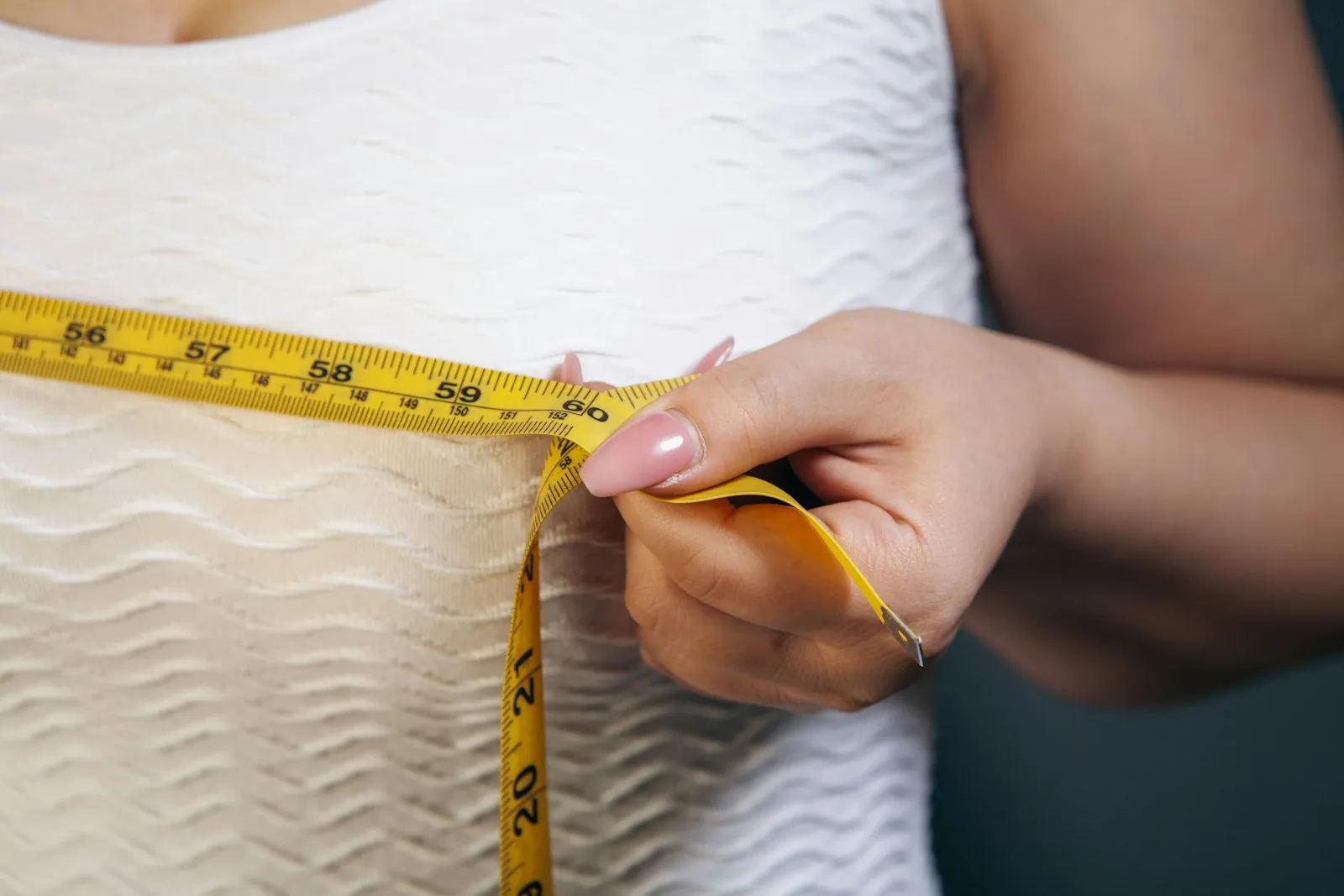
What do you need to measure your bra size?
A few unhurried minutes and three simple things.
A soft tape measure
A fabric or plastic tailor’s tape that follows the curve of your body.
A mirror
To check the tape stays level all the way round, especially at the back.
Somewhere to note it
Write down both numbers in the same unit, exactly as you read them.
Use one method consistently
These instructions match how our calculator works. Different methods round differently, so mixing instructions from one with the math of another can give a confusing result.
Measure without a bra, or in a non-padded bra that does not flatten or reshape you.
How do you measure your underbust (band)?
Wrap the tape around your ribcage directly beneath your bust, where the band of a bra sits. Keep it level all the way round and snug against your ribs, without digging in.
- Stand naturally and breathe out normally before reading the tape.
- Keep the tape firm but comfortable, as you would want a bra band to feel.
- Turn to the mirror to check the tape has not moved up or down at the back.
Enter the number you see on the tape. Don’t add 4 or 5 inches yourself. The calculator rounds the band for you.
Tape position and rounding tips
Breathing: don’t hold your breath or pull your stomach in. Read the tape after a normal breath out.
Between numbers: note the reading as accurately as you can, for example 31.5 in or 80 cm. The calculator rounds the band up to a whole inch, then up to the next even number (31.5 in → 32).
How do you measure your bust for cup size?
Wrap the tape around the fullest part of your bust, usually across the nipples. Keep it level and resting lightly, without pressing into breast tissue.
- Keep your arms relaxed by your sides.
- Check in the mirror that the tape is level across your back.
- Some retailers suggest leaning forward slightly to find the fullest point; either way, keep the tape relaxed.
The difference sets the cup: the cup comes from the difference between your bust and your band size, not from the bust measurement alone.
03 — Check your readings
A quick check before you work out your size.
- Both readings use the same unit
- The tape was level and not twisted at the back
- The underbust tape was snug
- The bust tape rested lightly without pressing in
Keep your measurements together
Enter your numbers to see a suggested starting size and how it was worked out.
Use this as the first size to try, then check how the band and cups fit.
Outside the range we can calculate
Why this result?
This follows the published UK tape method we use (no inches added to the band). Read the full method and its limits.
What do I do with my measurements?
A size is a starting point for trying bras on, not a fixed label for life.
“32”: the band
Comes from your underbust. A well-fitting band does most of the work of keeping a bra in place.
“DD”: the cup
Here, a 5-inch difference between the rounded bust and band. Cup letters are relative to their band.
Other systems
Systems diverge above DD: in the brand charts we checked, UK 32E is usually US 32DDD.
Is 34B or 32C bigger? They are sister sizes: the cups are approximately comparable, but the 34B has a looser band.
What are the most common bra measuring mistakes?
Small slips can change the band or cup by a size or more.
The tape slopes at the back
A tape that dips at the back gives a larger underbust reading, which can lead to a band that is too loose.
Try this: Turn sideways to a mirror and check the tape is level.
Pulling the bust tape tight
Pulling the bust tape as firmly as the underbust gives a smaller bust reading and a smaller cup.
Try this: Let the tape rest lightly on the fullest part.
Measuring over padding
Padded or push-up bras add to the bust measurement and change your shape.
Try this: Measure without a bra or in a non-padded one.
Adding inches to the band
Adding 4 or 5 inches is an older method. It tends to give a looser band and a smaller cup letter.
Try this: Enter the measurement as read; the calculator rounds it.
How do I measure my bra size without a measuring tape?
Use a length of non-stretch string or ribbon and a rigid ruler or a builder’s tape.
- 1
Wrap the string
Wrap it around your underbust, then your bust, in the same positions as above.
- 2
Mark where it meets
Pinch or mark the string where it meets itself at the front.
- 3
Measure the length
Lay it flat along a ruler and read the length up to your mark.
Stretchy materials such as phone cables or elastic will give an inaccurate reading.
Measured? Choose your next step
Get your starting size
Use the bra size calculator on our homepage for a full explanation of your result in your sizing system.
Check how a bra fits
Slipping straps, gaping cups or a band riding up? See what to check next.
Understand sister sizes
See which nearby sizes keep the cups approximately comparable with a different band.
Frequently asked questions
Should I measure in inches or centimeters?
Should I wear a bra while measuring?
Should I add inches to my underbust measurement?
Should you round odd band measurements up or down?
Why is my result different from the size I usually wear?
Will every bra in the suggested size fit the same?
How often should I measure my bra size?
Sources and review status
Sources last checked: . This page has not yet been reviewed by an independent professional bra fitter.
- How to measure your bra size (opens in a new tab) · Brastop Tape method without adding inches; one inch per cup, A to K.
- How to measure bra size (opens in a new tab) · Boux Avenue Same rounding rules; worked example subtracts the rounded band.
- Evaluation of professional bra fitting criteria for bra selection and fitting in the UK (Ergonomics, 2012) (opens in a new tab) · White & Scurr, University of Portsmouth
- Bra fit study, Journal of Science and Medicine in Sport 13(6):568–72 (2010) (opens in a new tab) · McGhee & Steele (PubMed 20451452)
Spotted something that looks wrong? Report a correction or read our sizing method.
Understand the method behind this guide
Read exactly how we round measurements, which published UK method we follow, and where its limits are.